Loss Aversion
Loss Aversion is a psychological principle suggesting that people are more motivated to avoid losses than to achieve equivalent gains. In UX design, loss aversion can be applied to encourage user actions by emphasizing what users stand to lose if they don’t take a specific action (e.g., “Only 2 items left in stock” or “Don’t miss out on this exclusive offer”). It is commonly used in sales, marketing, and behavioral nudges to drive conversions.
Loss aversion is one of the most reliable psychological levers in product design — humans feel the pain of loss roughly twice as strongly as the pleasure of equivalent gain. In SaaS, this means 'Don't lose your data' converts better than 'Back up your data,' and 'You're about to lose your 30-day streak' retains users better than 'Keep your streak going.' Framing product value in terms of what users would lose without it is consistently more persuasive than framing it in terms of what they gain.
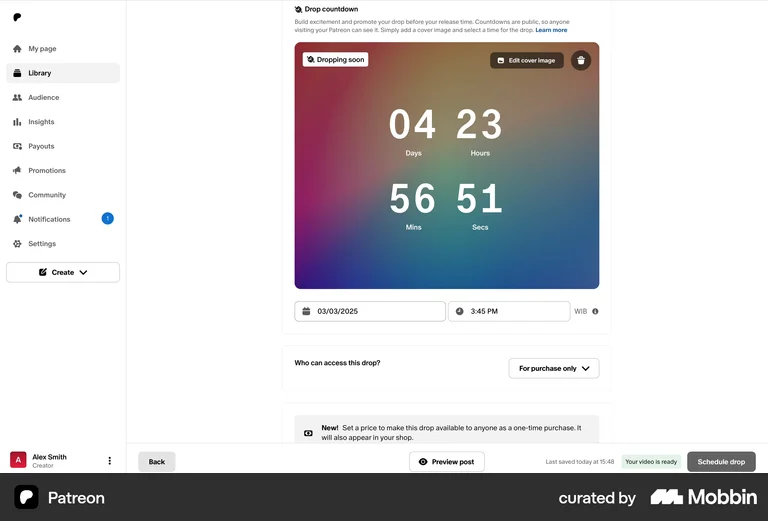
Patreon's Drop Countdown screen shows days, hours, minutes, and seconds ticking down alongside 'Dropping soon' — creating scarcity through time pressure that makes inaction feel like missing out on something that won't come back.